

act101
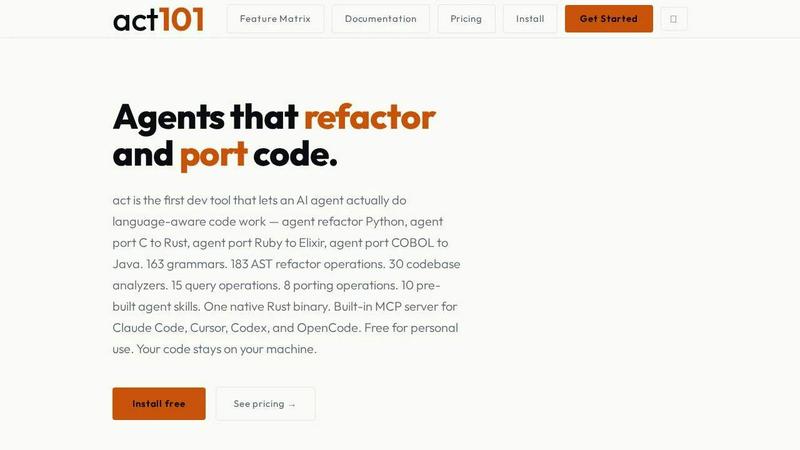
act is a single-binary MCP server that lets AI agents refactor and port code across 163 languages using AST operations.
About act101
act101 is a revolutionary developer tool that empowers AI coding agents to perform language-aware code refactoring and porting across an unprecedented 163 programming languages. Unlike traditional AI coding assistants that rely on whole-file rewrites, act101 provides a Model Context Protocol (MCP) server that exposes over 183 Abstract Syntax Tree (AST) refactor operations, 30 codebase analyzers, 15 query operations, and 8 porting operations directly to AI agents like Claude Code, Cursor, Codex, and OpenCode. The tool is built as a single native Rust binary with zero external dependencies, ensuring no plugin runtime, no package graph, and no supply-chain attack surface. It operates without indexing or caching, parsing code on demand to deliver results that are never stale. All code processing happens locally on the user's machine with no telemetry, making it ideal for security-conscious teams. act101 is free for personal use and offers a comprehensive suite of 10 pre-built agent skills that compose these operations into common engineering workflows such as architecture audits, code reviews, and migration assessments. The tool fundamentally changes what AI agents can accomplish by giving them typed, AST-aware operations that maintain code formatting, preserve comments, and provide automatic checkpointing with instant undo capabilities.
Features of act101
183 AST Refactor Operations
act101 provides AI agents with 183 distinct AST-aware refactor operations including extract-function, rename, move-symbol, inline, convert-to-dataclass, extract-trait, add-type-hints, generate-init, organize-imports, and 174 more. These operations work across the entire codebase with cross-file consistency, ensuring that when a symbol is renamed in one file, all references across the project are updated automatically. Each operation creates an automatic checkpoint, allowing instant undo if any change appears incorrect. This eliminates the common problems of lost comments, broken formatting, and unrecoverable changes associated with whole-file rewrites.
8 Cross-Language Porting Operations
The tool implements a sophisticated state machine for end-to-end language migration through four key operations: port_contract anchors the source-to-target migration, port_inventory enumerates every symbol that must move, port_order resolves dependency ordering, and port_manifest tracks progress through init, add, update, remove, and note states. This structured approach enables AI agents to port code between any two of the 163 supported grammars, such as converting C to Rust, Ruby to Elixir, or COBOL to Java, while maintaining code integrity and logical consistency throughout the migration process.
30 Codebase Analyzers
act101 includes 30 built-in codebase analyzers that provide deep structural insights into any codebase. These analyzers examine cohesion, coupling, cycles, chokepoints, hotspots, dead code, layers, seams, clusters, surface area, fan balance, migration readiness, and type completeness. Before making any changes, AI agents can use these analyzers to obtain a comprehensive structural map of the repository, enabling informed decisions about refactoring priorities, identifying problematic areas, and understanding the overall architecture. This analytical capability transforms code understanding from surface-level observation to deep structural awareness.
10 Pre-Built Agent Skills
The tool ships with 10 pre-built agent skills that compose individual operations into complete engineering workflows. These skills include architecture-audit, code-review, refactoring, code-navigation, code-generation, migration-assessment, boundary-analysis, change-impact, health-check, and architectural-refactoring. Users can invoke these skills directly within Claude Code, Cursor, or other MCP-aware clients using the /skill-name command. Each skill orchestrates multiple operations and analyzers to deliver comprehensive results, reducing the cognitive load on developers and enabling consistent, repeatable outcomes.
Use Cases of act101
Automated Code Refactoring Across Large Codebases
Engineering teams can use act101 to perform large-scale refactoring operations across entire codebases spanning hundreds of files and multiple programming languages. The AI agent can extract functions from complex methods, rename symbols consistently across all references, move modules between directories with automatic import updates, and convert classes to dataclasses or traits. The automatic checkpointing and instant undo capabilities make these operations safe for production codebases, while the AST-aware nature ensures that formatting and comments are preserved throughout the process.
Cross-Language Migration Projects
Organizations modernizing legacy systems can leverage act101 to port entire codebases between programming languages. The structured state machine approach guides AI agents through the complete migration workflow: establishing contracts between source and target languages, inventorying all symbols that must move, resolving dependency ordering, and tracking progress through the manifest system. This is particularly valuable for migrating COBOL systems to Java, transitioning Ruby applications to Elixir for better concurrency, or converting performance-critical C libraries to Rust for memory safety.
Code Quality Auditing and Analysis
Development teams can employ act101 to conduct comprehensive code quality audits without manual effort. The 30 codebase analyzers automatically detect coupling issues, circular dependencies, dead code, architectural hotspots, and boundary violations. The architecture-audit and health-check skills combine multiple analyzers to produce detailed reports on codebase structure and quality. This enables teams to identify technical debt, prioritize refactoring efforts, and maintain high code quality standards across growing codebases.
Architectural Boundary Analysis for Microservices
Teams planning microservice decompositions can use act101 to analyze module boundaries, identify seams in the codebase, and assess migration readiness. The boundary-analysis skill examines coupling patterns, fan-in and fan-out metrics, and dependency graphs to recommend optimal service boundaries. The change-impact skill predicts how modifications to specific modules will affect the rest of the system, enabling informed decisions about service extraction and helping teams avoid common pitfalls in microservice architecture transitions.
Frequently Asked Questions
How does act101 differ from traditional AI code assistants?
Traditional AI assistants rewrite entire files when making changes, which often loses comments, breaks formatting, and provides no undo capability. act101 operates at the AST level, performing precise, typed operations that preserve code structure and formatting. Each operation creates an automatic checkpoint for instant undo, and changes are applied with cross-file consistency. The tool also supports 163 languages versus the limited set supported by most assistants, and it runs entirely locally with no telemetry or external dependencies.
Does act101 require internet connectivity or cloud services?
No, act101 runs entirely on the user's machine as a native Rust binary. There is no indexing, no caching, and no cold start. The tool parses code on demand, so results are never stale. License verification may contact our servers, but your code never leaves your machine. There is no telemetry, no plugin runtime, and no package graph, making it suitable for air-gapped environments and security-sensitive projects.
Which AI coding agents are compatible with act101?
act101 is MCP-native and works with any MCP-aware client. It is specifically tested and compatible with Claude Code, Cursor, Windsurf, Codex, and OpenCode. The built-in MCP server exposes all 183 refactor operations, 30 analyzers, 15 query operations, and 8 porting operations to these agents. Users can invoke agent skills using the /skill-name command within supported clients.
Is act101 free to use and what are the limitations?
act101 is free for personal use with no limitations on features or language support. All 163 grammars, 183 refactor operations, 30 analyzers, 15 query operations, 8 porting operations, and 10 pre-built agent skills are available in the free tier. For commercial or team usage, there are paid pricing plans that offer additional features such as priority support, team management, and advanced analytics.
Similar to act101

Product Launch Checklist
A free launch checklist for SaaS, apps, AI tools and more. Every step says why it matters and when you can skip it.

Forms Plugin
The #1 Native Form Builder Plugin for Framer - No Code, No Embeds, No External Platforms.

Chatit Me - Free Random Chat Alternative
Chat with random strangers online for free on ChatIt.me. Enjoy safe, anonymous, and instant 1-on-1 conversations with people worldwide

Slaky
AI Visibility rankings for startups with verified metrics

VidhyaGen
Fast, free, and privacy-first browser tool to convert, crop, resize, and compress images locally without server uploads.


PNG to SVG
Free, private image conversion tools that run entirely in your browser.