

Frizzle
Frizzle uses AI to analyze handwritten math work in real time, giving teachers granular data on student misconceptions and next steps.
About Frizzle
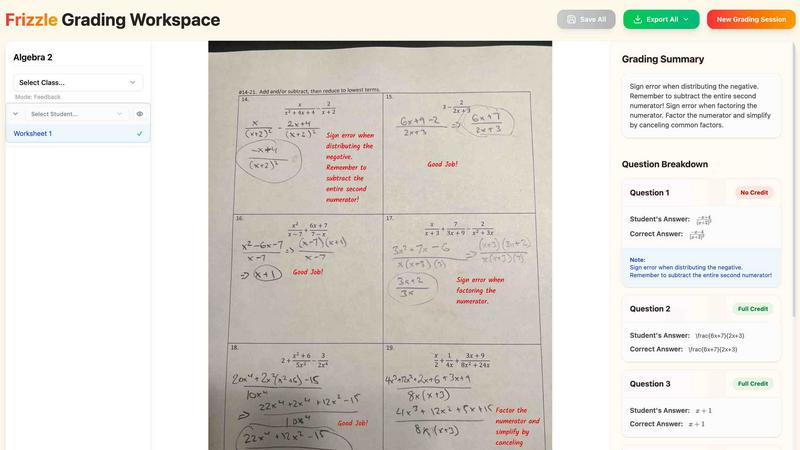
Frizzle is an AI-powered platform designed to transform how math classrooms operate by reading and analyzing handwritten student work. It combines computer vision and large language models (LLMs) to grade handwritten math with 97% accuracy, while also providing a confidence-interval system that flags uncertain grades for human review. The product is built for K-12 math teachers, instructional coaches, and school districts who want to move beyond traditional grading and gain real-time, granular insights into student understanding. Students continue to write on paper using their normal workflow, while teachers simply photograph a stack of papers or run them through a copier. Within minutes, Frizzle reads every page, recognizes multiple solution paths, and generates standards-level formative analytics aligned to frameworks like CCSS and TEKS. The result is that math teachers reclaim the 10 to 15 hours per week they typically spend grading by hand, coaches can have specific, data-driven conversations instead of generic ones, and districts can reduce math screen time without losing the classroom-level data they need. Frizzle is already live in over 30 schools and districts, including a college math pilot at Vanderbilt and Arizona State University, and has graded over 100,000 questions. The platform is FERPA and COPPA compliant, ensuring student data privacy is never compromised.
Features of Frizzle
Handwriting Recognition for Any Style
Frizzle reads any form of handwriting, including print, cursive, scribbled, or sideways text. This capability ensures that students are not penalized for their handwriting style, and teachers can submit any stack of papers without needing to standardize how students write. The computer vision model parses each step of student work, not just the final answer, allowing for accurate and fair grading across diverse classrooms.
Multiple Solution Path Recognition
Unlike traditional grading tools that only check for one correct method, Frizzle understands and credits multiple solution paths. For example, if three students solve a quadratic equation using factoring, square roots, and the quadratic formula respectively, Frizzle recognizes all three as valid approaches. This feature encourages mathematical creativity and ensures that students are assessed on their understanding rather than memorization of a single procedure.
Step-Level Misconception Detection
Frizzle provides feedback at the individual step level, identifying exactly where a student's thinking went wrong rather than simply marking an answer as incorrect. The system has been trained on 1.4 million pages of K-12 student work and recognizes 147 named misconceptions across math standards. It also performs prerequisite tracing, meaning it can identify when a 7th-grade error is actually caused by a 4th-grade skill gap, enabling targeted intervention.
Live Classroom and District Dashboards
Frizzle generates live dashboards that show who is stuck, which misconceptions are spreading across the class, and what should be taught next. For individual teachers, this means seeing a class overview in about 8 minutes. For schools and districts, the platform aggregates anonymized data across periods, grades, and buildings, providing equity dashboards, standards mastery tracking, and curriculum-agnostic analytics that work with Eureka, Illustrative, Saxon, and other curricula.
Use Cases of Frizzle
Individual Teacher Grading and Planning
A middle school math teacher with five classes of 30 students each can photograph a stack of papers after a quiz and have Frizzle read every page in about 30 seconds. Within 8 minutes, the teacher sees which students mastered the standard, which are developing, and which are at risk. The teacher can then plan the next day's lesson based on real data, addressing specific misconceptions before they compound.
Instructional Coaching with Data
A math coach can use Frizzle's dashboards to run specific, standards-level conversations with teachers instead of generic coaching sessions. For example, the coach can see that Period 2 is struggling with distributive property while Period 5 has mastered it. The coach can then model a targeted reteach for Period 2, using the exact student work examples flagged by Frizzle as evidence.
District-Wide Curriculum Evaluation
A district curriculum coordinator can use Frizzle's aggregated data to evaluate which math curricula are actually working across different schools. By looking at standards mastery rates, misconception patterns, and engagement metrics, the coordinator can make informed decisions about curriculum adoption, professional development investments, and resource allocation without waiting for spring assessments.
College Math Remediation and Placement
In college settings like the pilots at Vanderbilt and ASU, Frizzle can be used to assess foundational math skills for incoming students. By analyzing handwritten work on placement tests, the system identifies specific gaps in prerequisite knowledge. Advisors and instructors can then place students into the appropriate course level or provide targeted remediation, reducing the need for costly remedial courses and improving student success rates.
Frequently Asked Questions
How does Frizzle handle student privacy and data security?
Frizzle is built with privacy as a foundational principle, not a checkbox. The platform is fully FERPA and COPPA compliant and undergoes SOC 2 Type II audits annually. Student work never trains the underlying model, meaning your students' data stays yours. All data is encrypted using AES-256 at rest and TLS in transit, ensuring end-to-end security.
Does Frizzle require students to use tablets or computers?
No. Frizzle is designed to work with the existing paper-based workflow that most math classrooms already use. Students continue to write on paper with pencils, and teachers simply photograph the work using a phone, document camera, or scanner. There are no new logins for students, no devices to distribute, and no migration of classroom routines required.
What standards and curricula does Frizzle support?
Frizzle supports alignment with Common Core State Standards (CCSS), Texas Essential Knowledge and Skills (TEKS), and over 30 additional state frameworks. The platform is curriculum-agnostic, meaning it can read and analyze student work from any math curriculum, including Eureka, Illustrative Mathematics, Saxon, and others. The system has been trained on 1.4 million pages of K-12 student work to understand diverse problem types.
How accurate is Frizzle's grading and what happens to uncertain grades?
Frizzle grades handwritten math with 97% accuracy. For the remaining 3% of papers where the system is uncertain, it uses a confidence-interval system that flags those grades for human review. Teachers can quickly check the flagged papers and confirm or correct the grade. This hybrid approach ensures high efficiency while maintaining accuracy and teacher oversight for edge cases.
Similar to Frizzle

Wordy
Learn languages with real movie and TV show clips.

PDFKing
PDFKing is a free online PDF toolkit designed to make everyday document tasks simple, fast, and accessible. It brings essential PDF tools together in


Registrant Prep
Registrant Prep is an affordable AI-powered platform that replaces costly CSI prep for the 2026 CIRO exams with cited rules, full mocks, and an AI.

CIROExam
CIROExam offers affordable AI-powered CIRO prep with rule-cited explanations, replacing costly CSI courses for all nine exams.

Superday AI
Superday AI is the ultimate investment banking interview prep tool, offering personalized coaching and real questions from top banks.